Full sample report / 18 pages
Signup was easy.
What came next wasn’t.
A first-time SaaS journey: finding help, following it, hitting a prerequisite and recovering.
Relaynest · One reviewer’s first-time setup journey. Rebranded screens illustrate the source observations; they are not client logos or measured success claims.
Read page 1 text
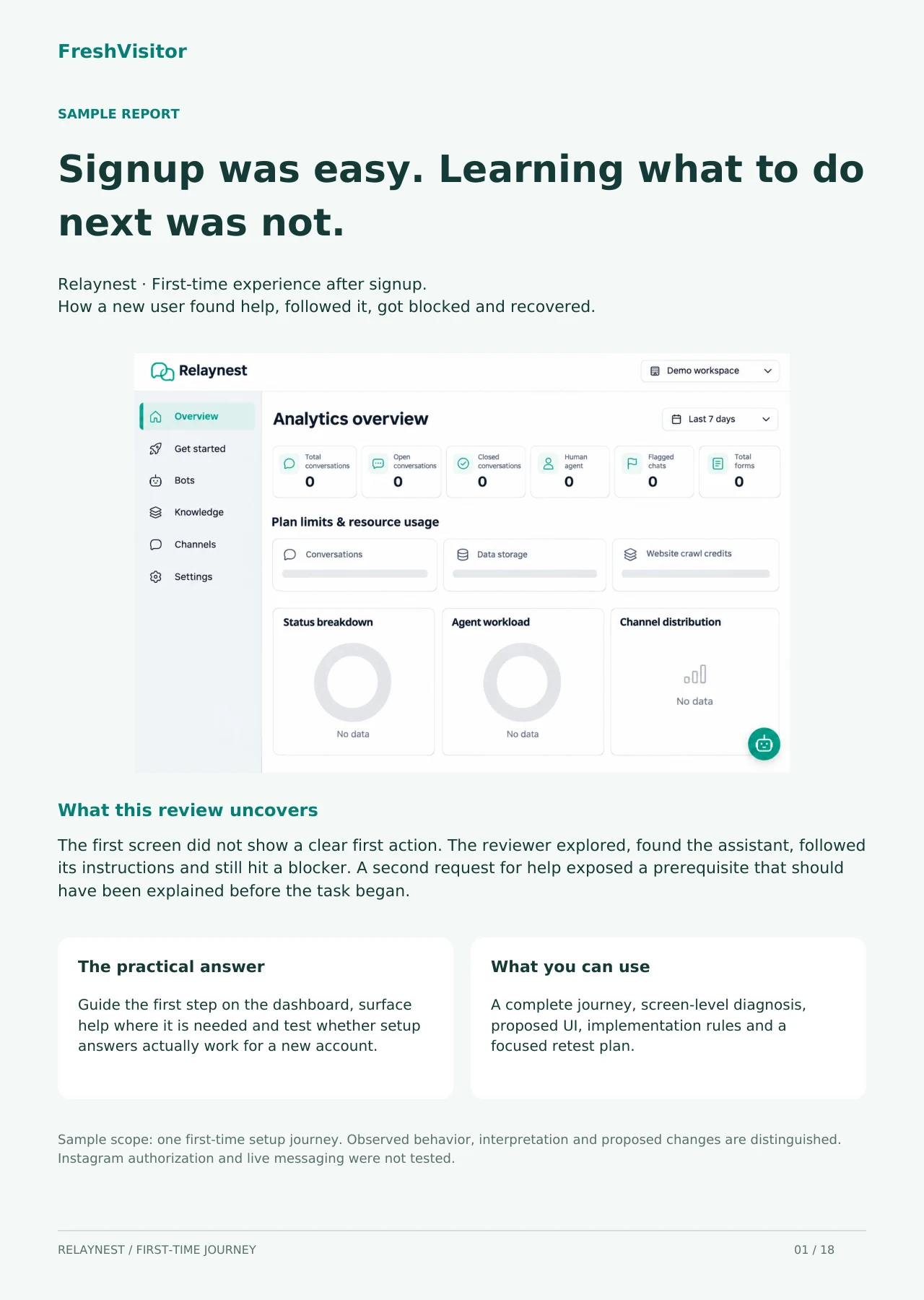
FreshVisitor RELAYNEST / FIRST-TIME JOURNEY 01 / 18 SAMPLE REPORT Signup was easy. Learning what to do next was not. Relaynest · First-time experience after signup. How a new user found help, followed it, got blocked and recovered. What this review uncovers The first screen did not show a clear first action. The reviewer explored, found the assistant, followed its instructions and still hit a blocker. A second request for help exposed a prerequisite that should have been explained before the task began. The practical answer Guide the first step on the dashboard, surface help where it is needed and test whether setup answers actually work for a new account. What you can use A complete journey, screen-level diagnosis, proposed UI, implementation rules and a focused retest plan. Sample scope: one first-time setup journey. Observed behavior, interpretation and proposed changes are distinguished. Instagram authorization and live messaging were not tested.
Read page 2 text
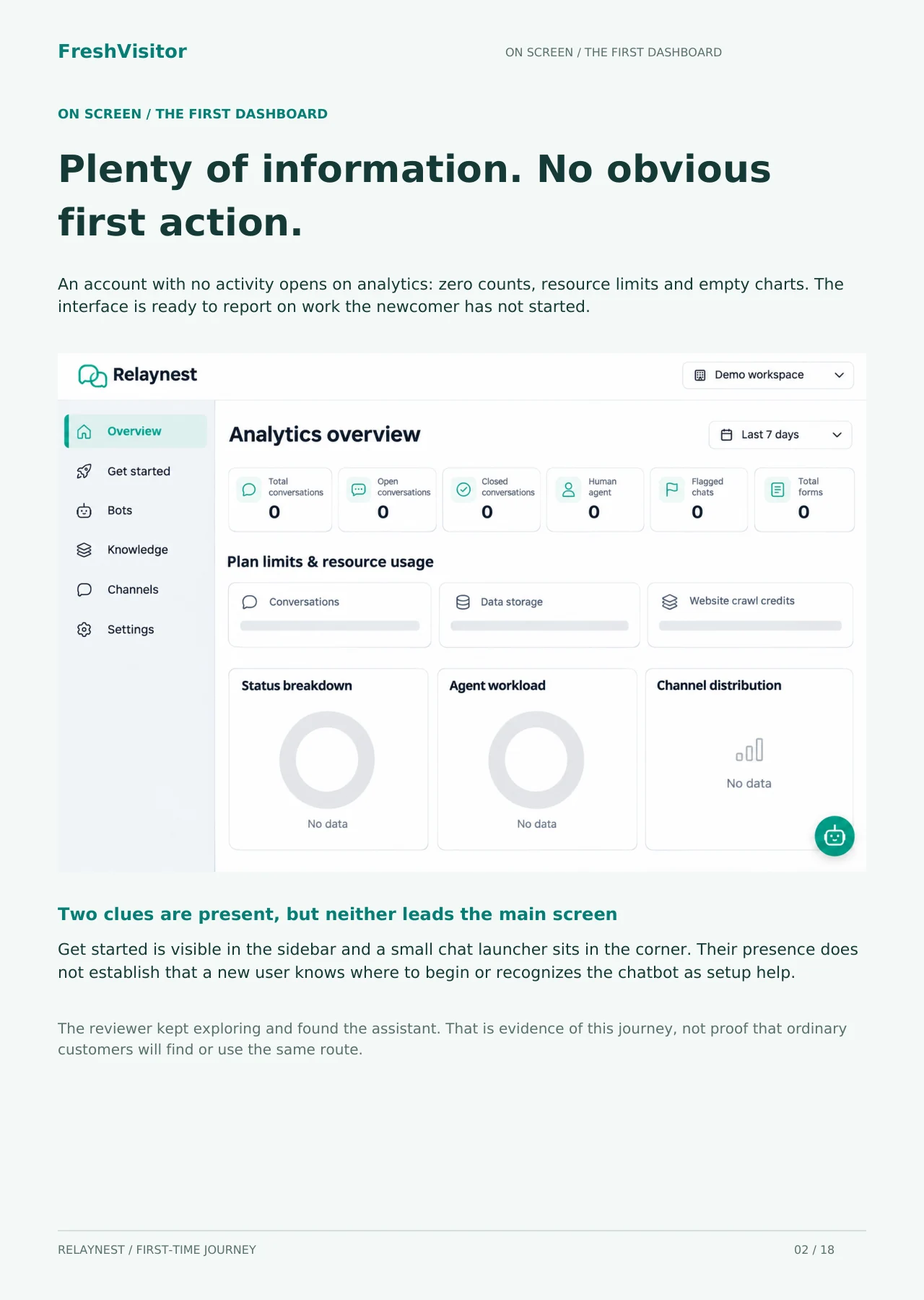
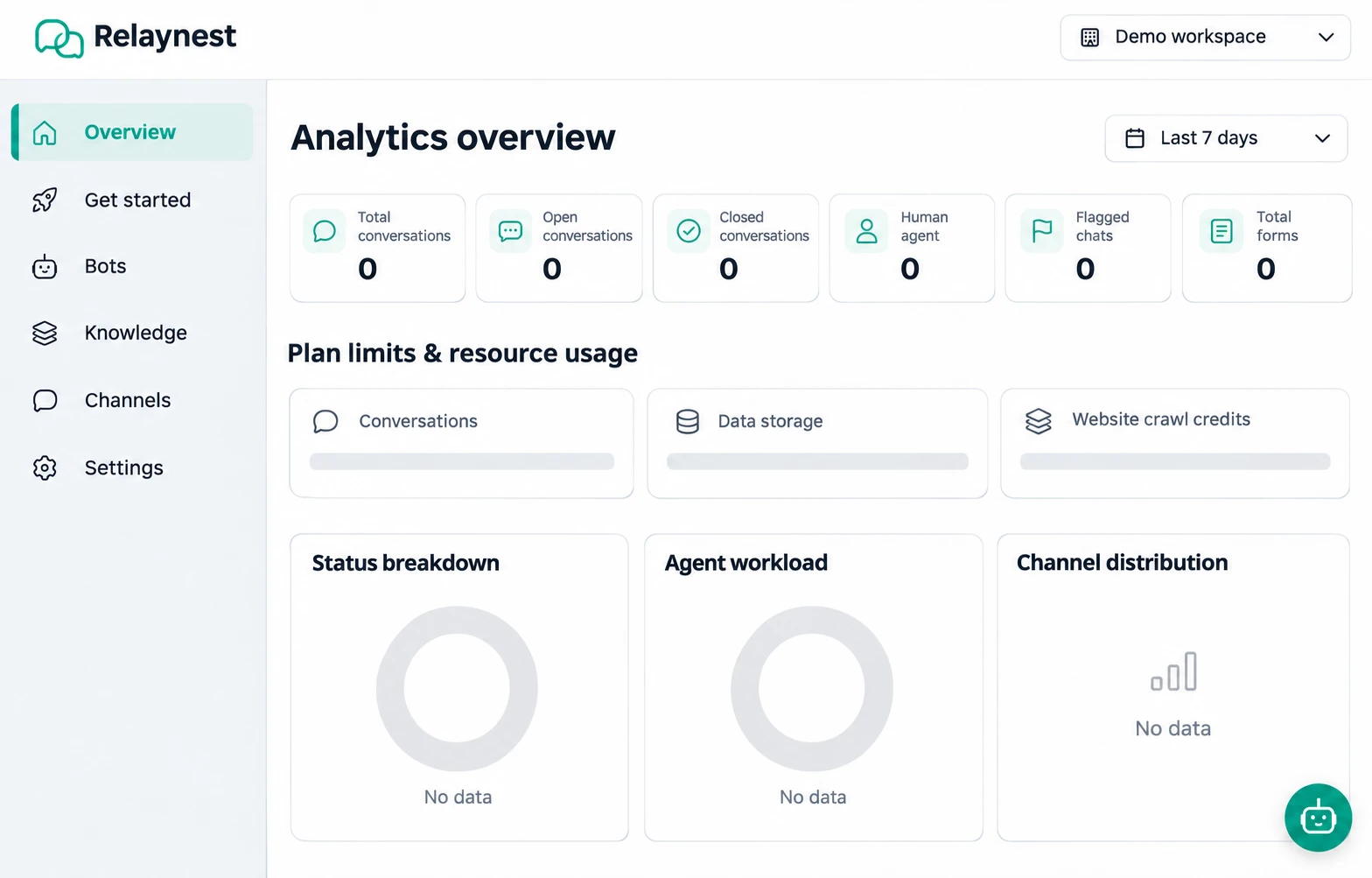
FreshVisitor ON SCREEN / THE FIRST DASHBOARD RELAYNEST / FIRST-TIME JOURNEY 02 / 18 ON SCREEN / THE FIRST DASHBOARD Plenty of information. No obvious first action. An account with no activity opens on analytics: zero counts, resource limits and empty charts. The interface is ready to report on work the newcomer has not started. Two clues are present, but neither leads the main screen Get started is visible in the sidebar and a small chat launcher sits in the corner. Their presence does not establish that a new user knows where to begin or recognizes the chatbot as setup help. The reviewer kept exploring and found the assistant. That is evidence of this journey, not proof that ordinary customers will find or use the same route.
Read page 3 text
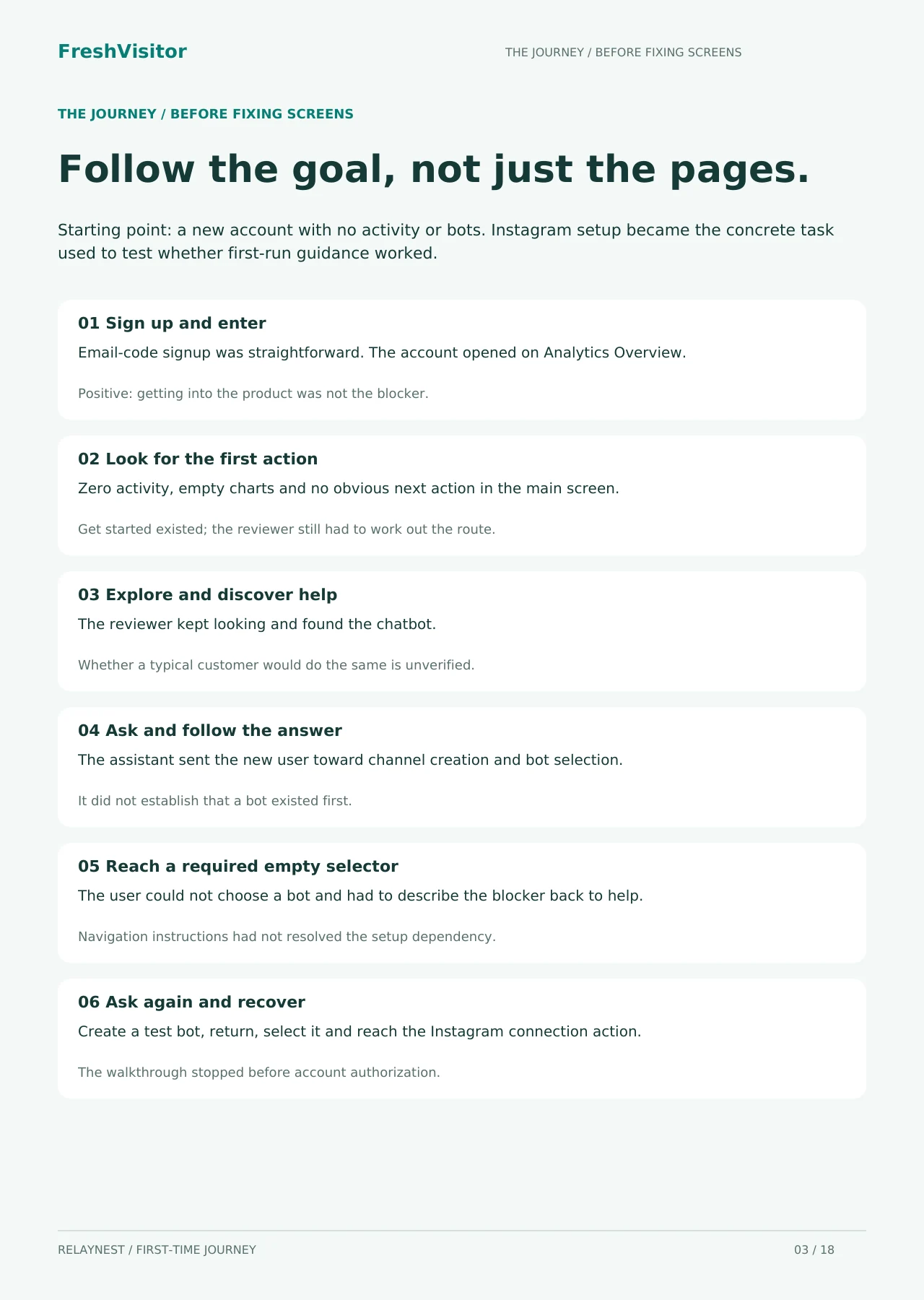
FreshVisitor THE JOURNEY / BEFORE FIXING SCREENS RELAYNEST / FIRST-TIME JOURNEY 03 / 18 THE JOURNEY / BEFORE FIXING SCREENS Follow the goal, not just the pages. Starting point: a new account with no activity or bots. Instagram setup became the concrete task used to test whether first-run guidance worked. 01 Sign up and enter Email-code signup was straightforward. The account opened on Analytics Overview. Positive: getting into the product was not the blocker. 02 Look for the first action Zero activity, empty charts and no obvious next action in the main screen. Get started existed; the reviewer still had to work out the route. 03 Explore and discover help The reviewer kept looking and found the chatbot. Whether a typical customer would do the same is unverified. 04 Ask and follow the answer The assistant sent the new user toward channel creation and bot selection. It did not establish that a bot existed first. 05 Reach a required empty selector The user could not choose a bot and had to describe the blocker back to help. Navigation instructions had not resolved the setup dependency. 06 Ask again and recover Create a test bot, return, select it and reach the Instagram connection action. The walkthrough stopped before account authorization.
Read page 4 text
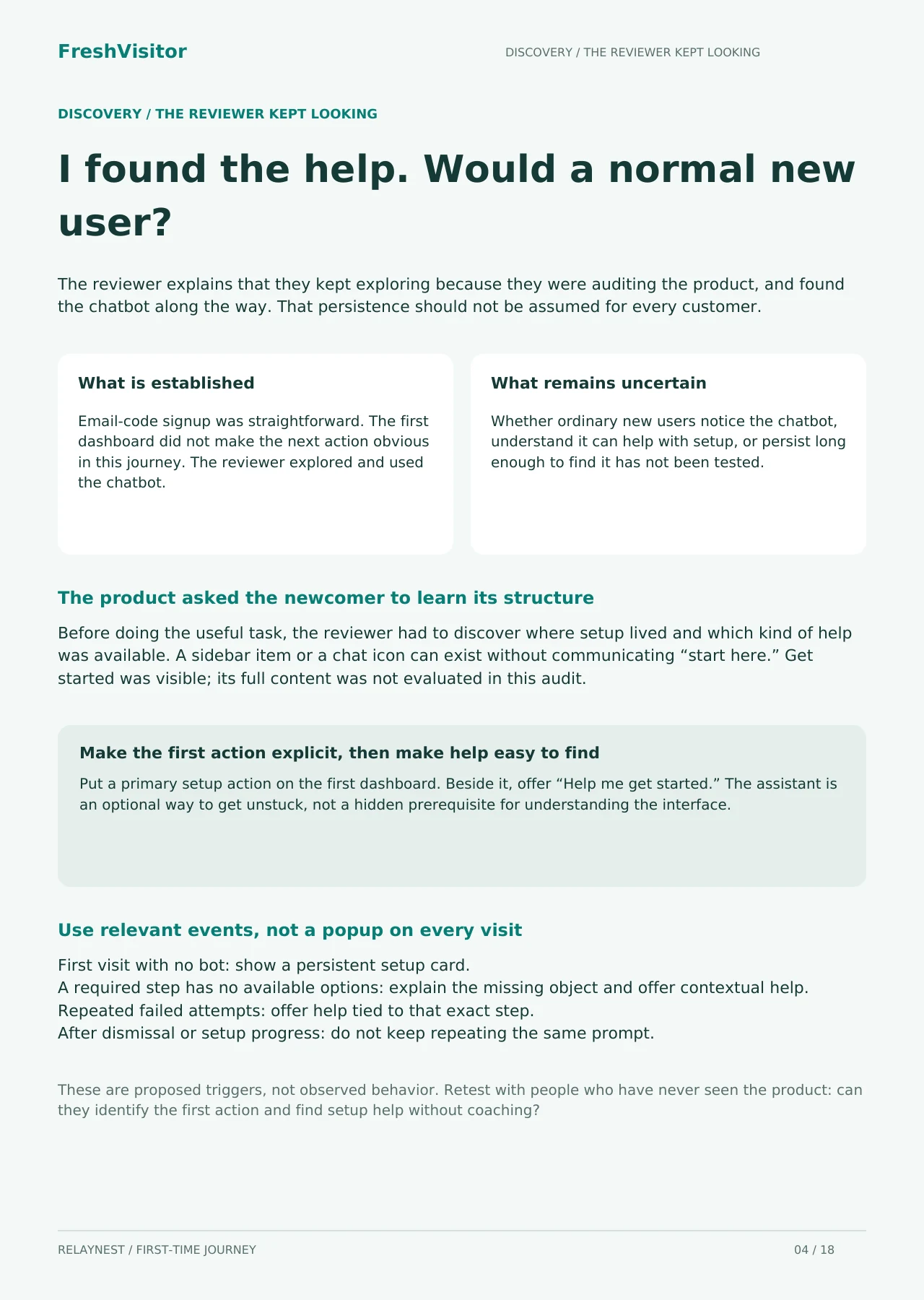
FreshVisitor DISCOVERY / THE REVIEWER KEPT LOOKING RELAYNEST / FIRST-TIME JOURNEY 04 / 18 DISCOVERY / THE REVIEWER KEPT LOOKING I found the help. Would a normal new user? The reviewer explains that they kept exploring because they were auditing the product, and found the chatbot along the way. That persistence should not be assumed for every customer. What is established Email-code signup was straightforward. The first dashboard did not make the next action obvious in this journey. The reviewer explored and used the chatbot. What remains uncertain Whether ordinary new users notice the chatbot, understand it can help with setup, or persist long enough to find it has not been tested. The product asked the newcomer to learn its structure Before doing the useful task, the reviewer had to discover where setup lived and which kind of help was available. A sidebar item or a chat icon can exist without communicating “start here.” Get started was visible; its full content was not evaluated in this audit. Make the first action explicit, then make help easy to find Put a primary setup action on the first dashboard. Beside it, offer “Help me get started.” The assistant is an optional way to get unstuck, not a hidden prerequisite for understanding the interface. Use relevant events, not a popup on every visit First visit with no bot: show a persistent setup card. A required step has no available options: explain the missing object and offer contextual help. Repeated failed attempts: offer help tied to that exact step. After dismissal or setup progress: do not keep repeating the same prompt. These are proposed triggers, not observed behavior. Retest with people who have never seen the product: can they identify the first action and find setup help without coaching?
Read page 5 text
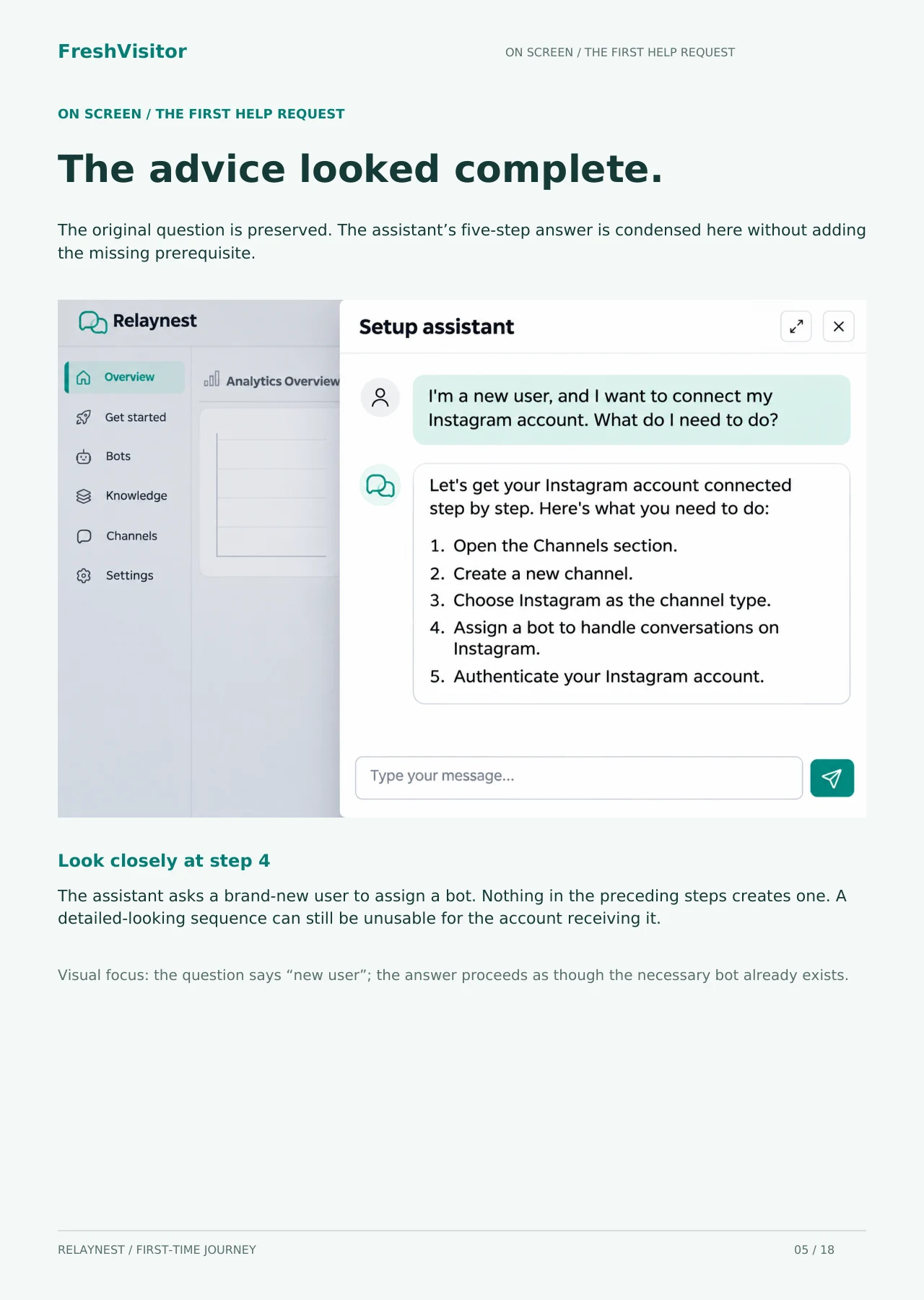
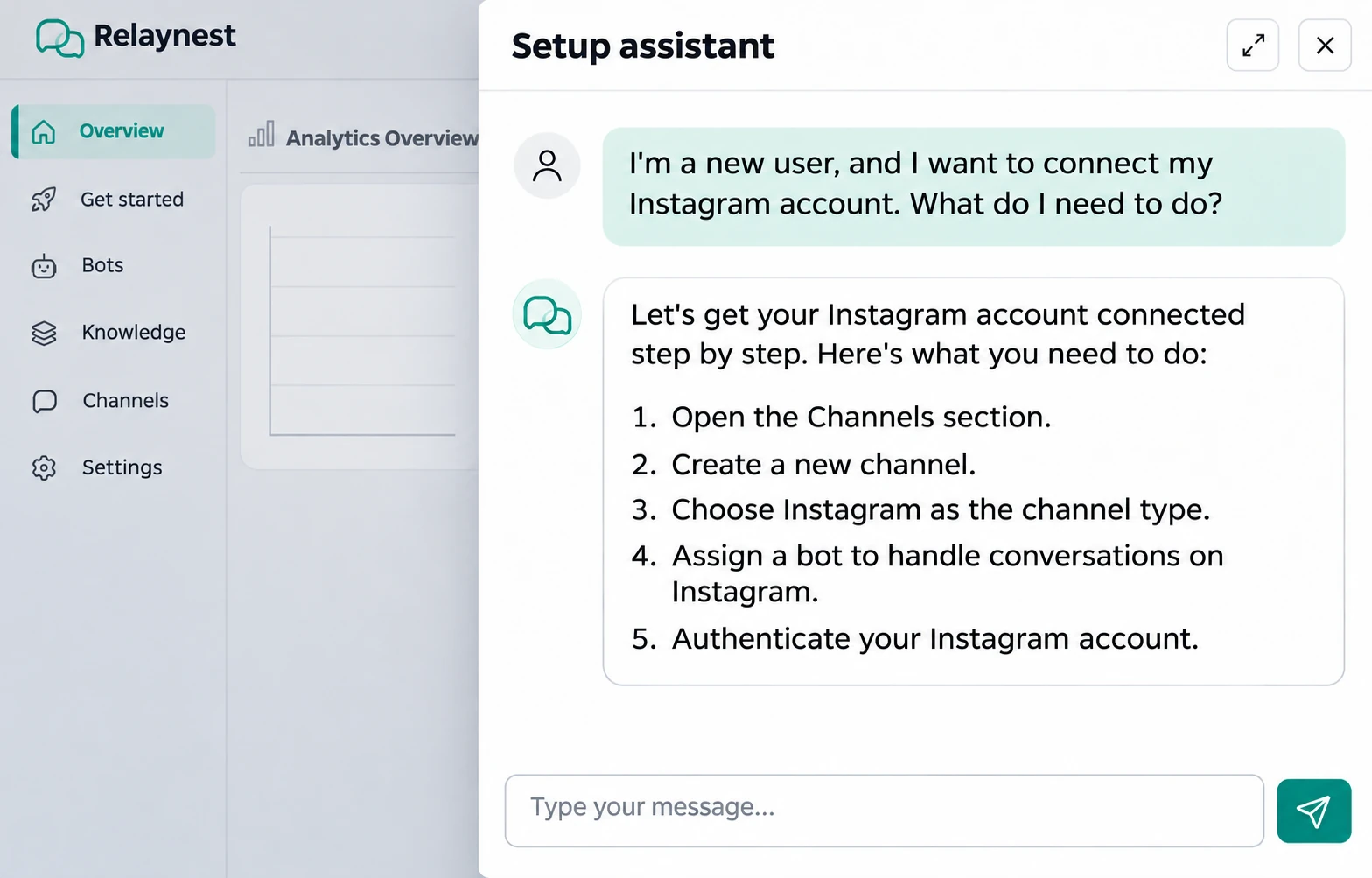
FreshVisitor ON SCREEN / THE FIRST HELP REQUEST RELAYNEST / FIRST-TIME JOURNEY 05 / 18 ON SCREEN / THE FIRST HELP REQUEST The advice looked complete. The original question is preserved. The assistant’s five-step answer is condensed here without adding the missing prerequisite. Look closely at step 4 The assistant asks a brand-new user to assign a bot. Nothing in the preceding steps creates one. A detailed-looking sequence can still be unusable for the account receiving it. Visual focus: the question says “new user”; the answer proceeds as though the necessary bot already exists.
Read page 6 text
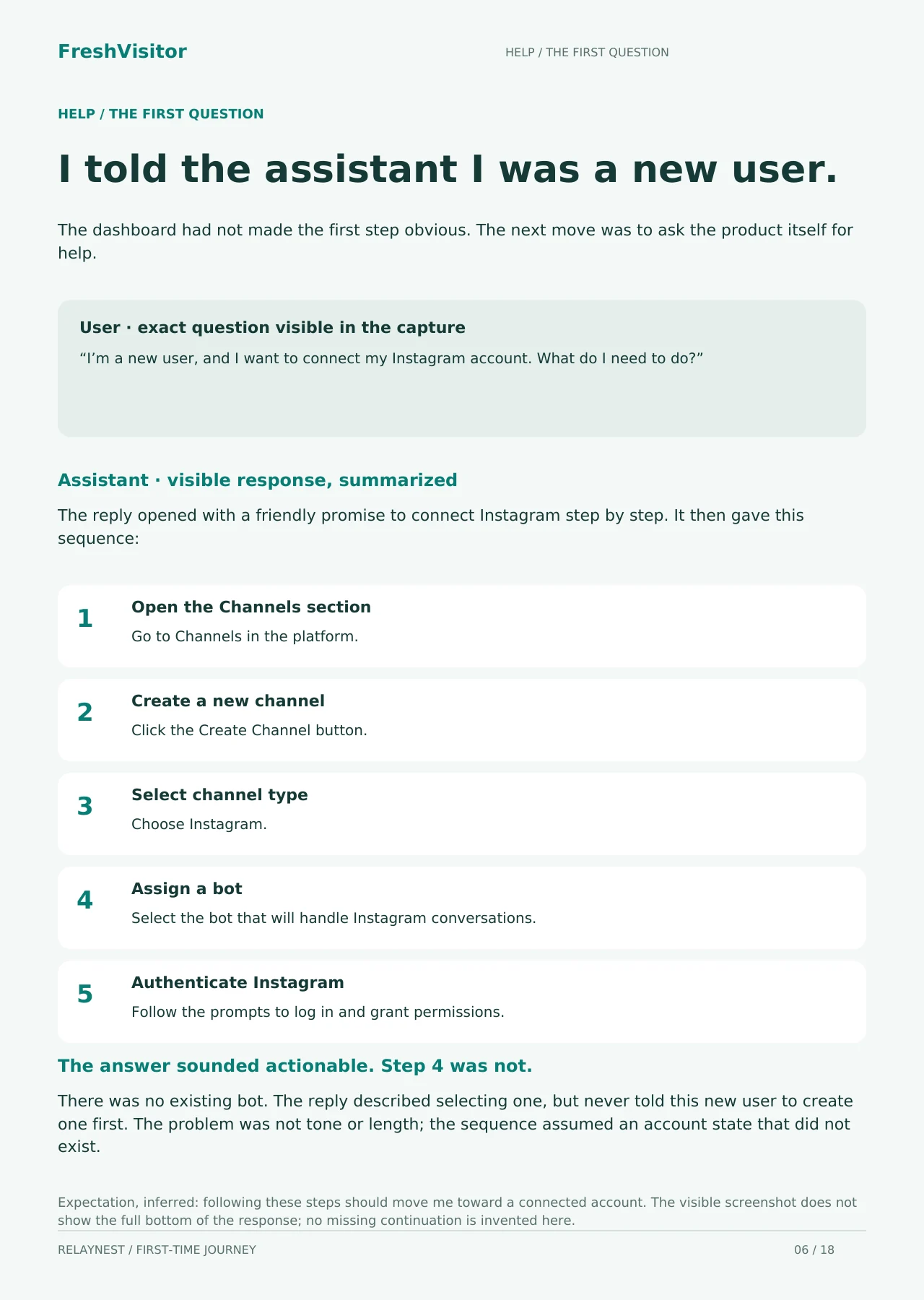
FreshVisitor HELP / THE FIRST QUESTION RELAYNEST / FIRST-TIME JOURNEY 06 / 18 HELP / THE FIRST QUESTION I told the assistant I was a new user. The dashboard had not made the first step obvious. The next move was to ask the product itself for help. User · exact question visible in the capture “I’m a new user, and I want to connect my Instagram account. What do I need to do?” Assistant · visible response, summarized The reply opened with a friendly promise to connect Instagram step by step. It then gave this sequence: 1 Open the Channels section Go to Channels in the platform. 2 Create a new channel Click the Create Channel button. 3 Select channel type Choose Instagram. 4 Assign a bot Select the bot that will handle Instagram conversations. 5 Authenticate Instagram Follow the prompts to log in and grant permissions. The answer sounded actionable. Step 4 was not. There was no existing bot. The reply described selecting one, but never told this new user to create one first. The problem was not tone or length; the sequence assumed an account state that did not exist. Expectation, inferred: following these steps should move me toward a connected account. The visible screenshot does not show the full bottom of the response; no missing continuation is invented here.
Read page 7 text
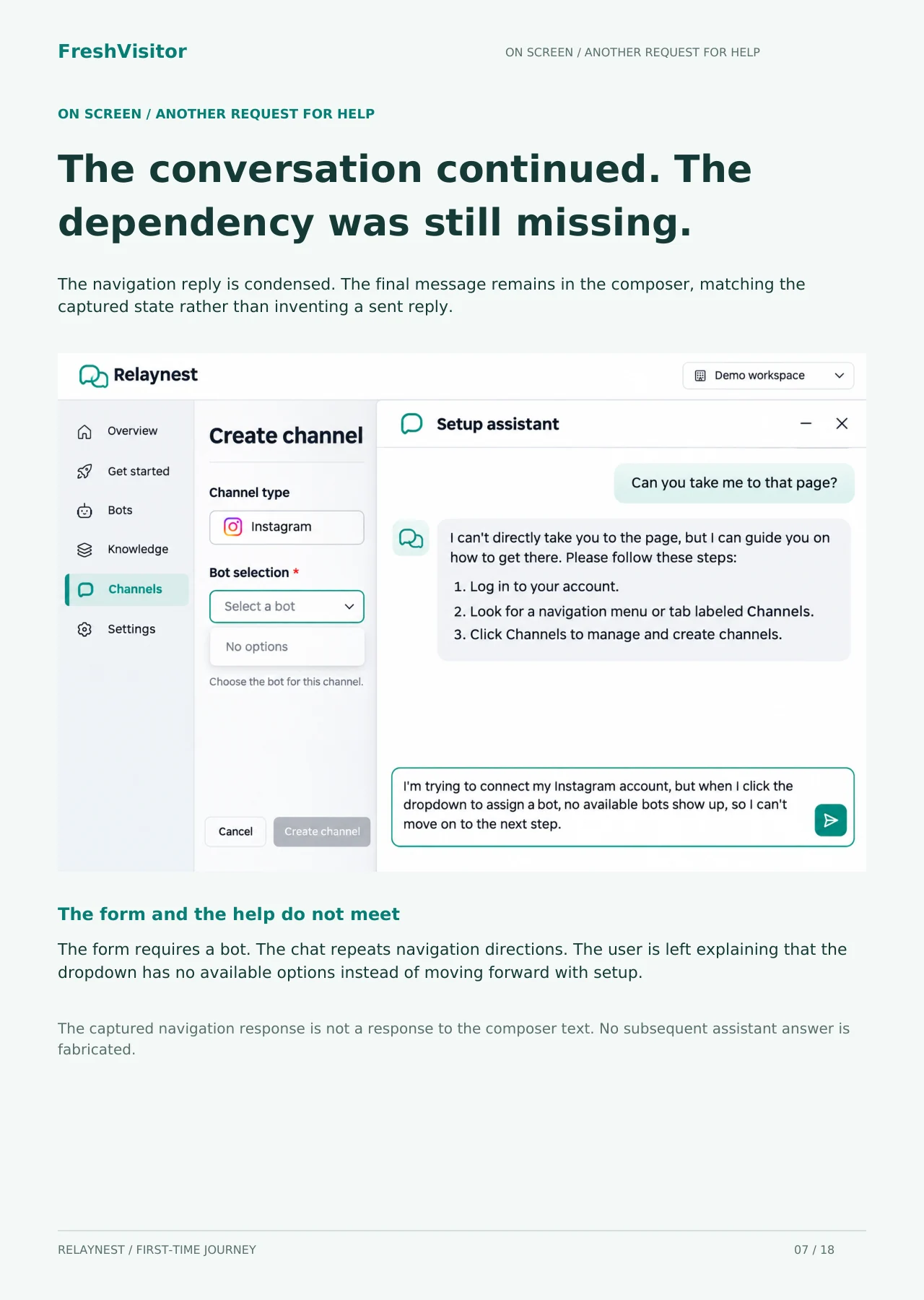
FreshVisitor ON SCREEN / ANOTHER REQUEST FOR HELP RELAYNEST / FIRST-TIME JOURNEY 07 / 18 ON SCREEN / ANOTHER REQUEST FOR HELP The conversation continued. The dependency was still missing. The navigation reply is condensed. The final message remains in the composer, matching the captured state rather than inventing a sent reply. The form and the help do not meet The form requires a bot. The chat repeats navigation directions. The user is left explaining that the dropdown has no available options instead of moving forward with setup. The captured navigation response is not a response to the composer text. No subsequent assistant answer is fabricated.
Read page 8 text
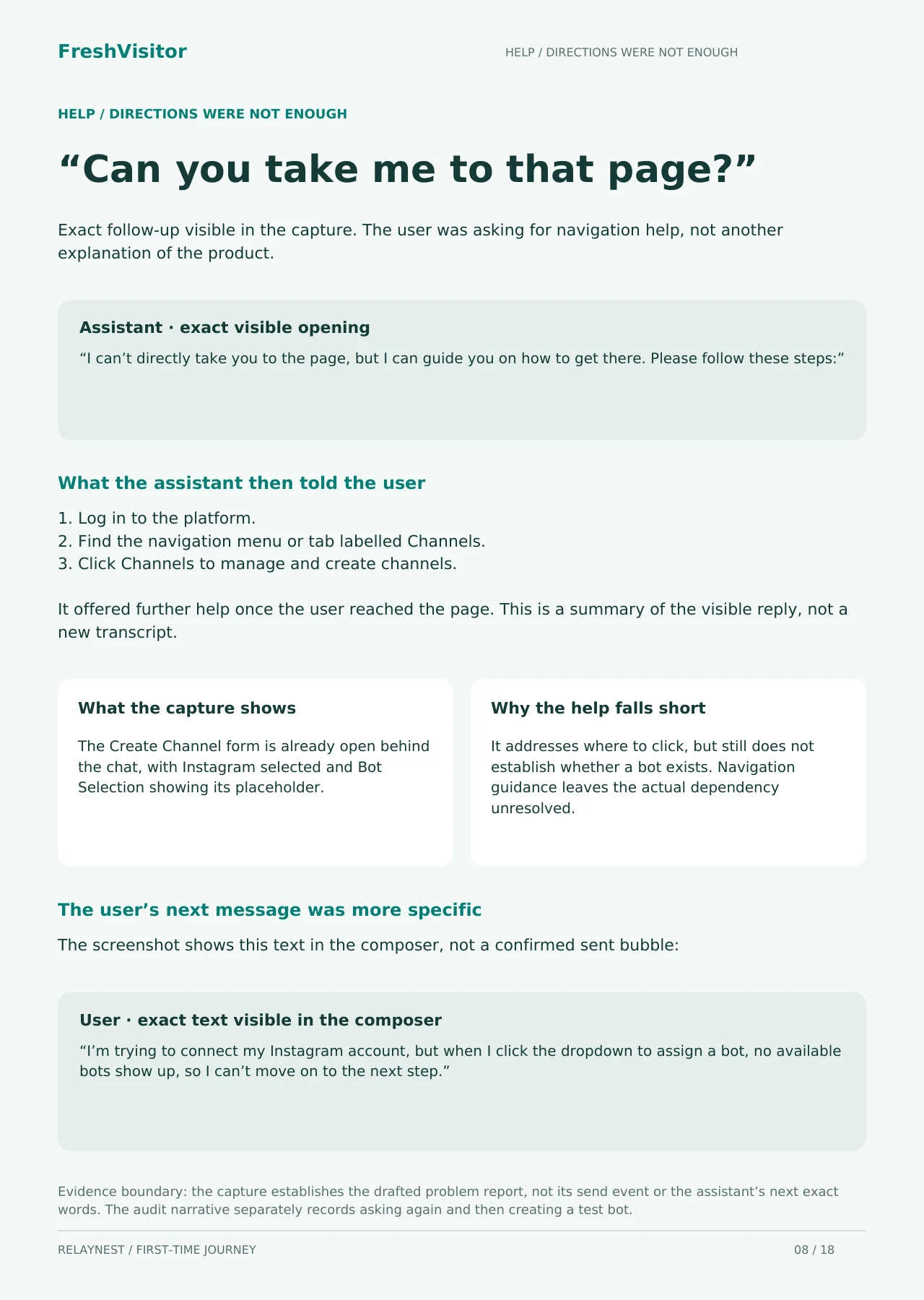
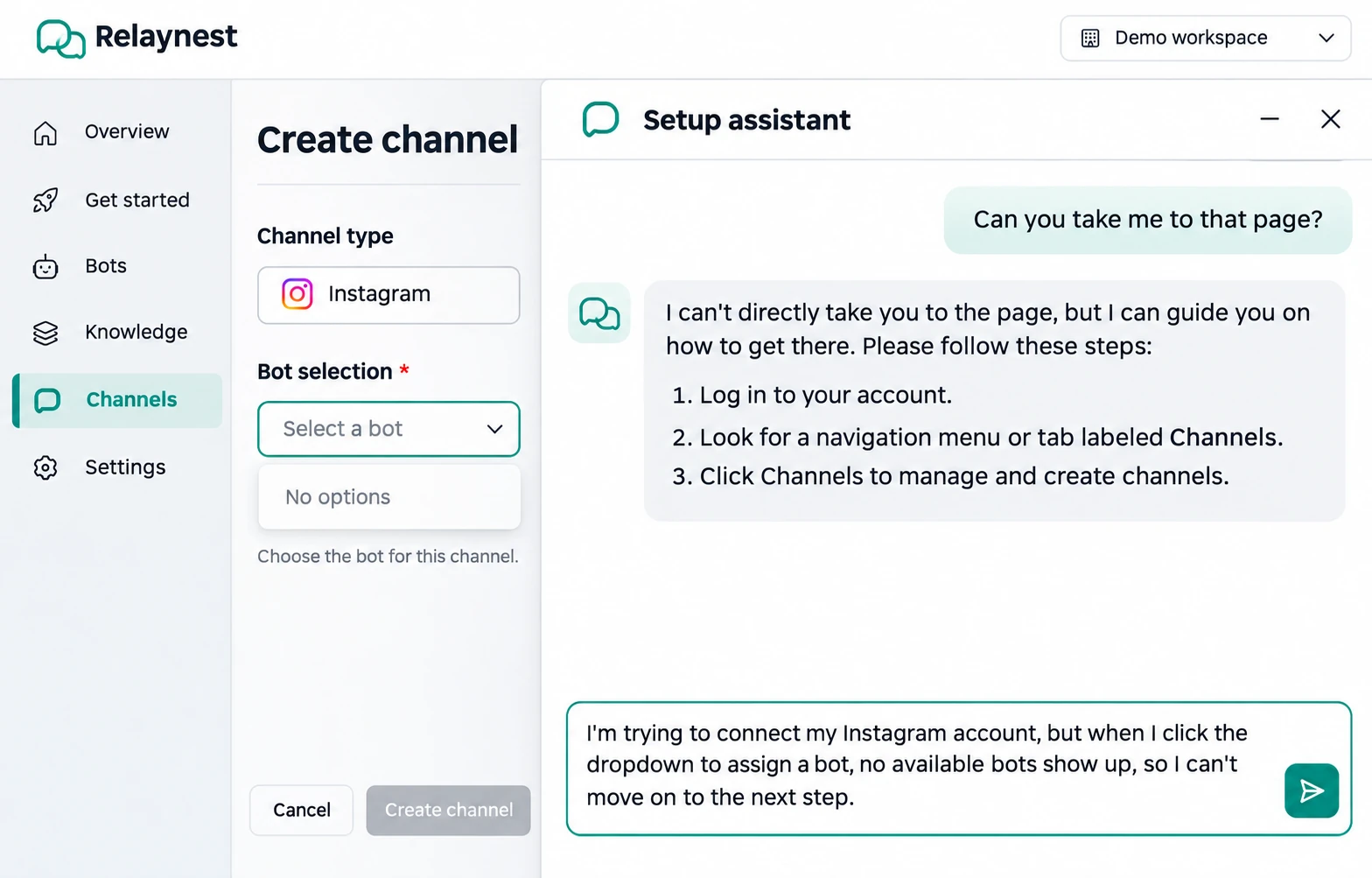
FreshVisitor HELP / DIRECTIONS WERE NOT ENOUGH RELAYNEST / FIRST-TIME JOURNEY 08 / 18 HELP / DIRECTIONS WERE NOT ENOUGH “Can you take me to that page?” Exact follow-up visible in the capture. The user was asking for navigation help, not another explanation of the product. Assistant · exact visible opening “I can’t directly take you to the page, but I can guide you on how to get there. Please follow these steps:” What the assistant then told the user 1. Log in to the platform. 2. Find the navigation menu or tab labelled Channels. 3. Click Channels to manage and create channels. It offered further help once the user reached the page. This is a summary of the visible reply, not a new transcript. What the capture shows The Create Channel form is already open behind the chat, with Instagram selected and Bot Selection showing its placeholder. Why the help falls short It addresses where to click, but still does not establish whether a bot exists. Navigation guidance leaves the actual dependency unresolved. The user’s next message was more specific The screenshot shows this text in the composer, not a confirmed sent bubble: User · exact text visible in the composer “I’m trying to connect my Instagram account, but when I click the dropdown to assign a bot, no available bots show up, so I can’t move on to the next step.” Evidence boundary: the capture establishes the drafted problem report, not its send event or the assistant’s next exact words. The audit narrative separately records asking again and then creating a test bot.
Read page 9 text
FreshVisitor HELP / WHY THE LOOP HAPPENED RELAYNEST / FIRST-TIME JOURNEY 09 / 18 HELP / WHY THE LOOP HAPPENED The user followed the help. Then had to diagnose its missing step. A common first-user question must produce a usable setup path. Friendly wording alone is not enough if following it sends a new account into a dead end. The chain of friction Unclear first action → ask support → receive a channel-first sequence → navigate to the form → reach a required but empty selector → describe the blocker back to support → discover bot creation → leave the task and return. Observed The initial reply omitted bot creation. The selector had no available bot. A test bot was later created and became selectable. Interpretation The user has to work out whether the problem is navigation, missing setup or a malfunction. An apparently complete answer can make that uncertainty harder to resolve. Fix the sequence before adding smarter-sounding prose Check the prerequisite first. If account state is available, branch on bot count. If it is not available, explicitly ask the user to check Bots or provide both paths. Never pretend the assistant inspected the account. Proposed reply · new account with no bot “You’ll need a bot before you can create the Instagram channel. Create your first bot under Bots, then return to Channels, choose Instagram, and select it.” This is proposed wording, not an observed assistant response. What is higher priority than a deep link Make the empty selector recoverable without support. The assistant should reinforce a clear workflow, not be the only way to discover how the product works. Direct navigation can help later, but it will not correct the missing prerequisite by itself. Retest: ask the same setup question with zero bots and with an existing bot. Then follow the answer literally. Does every required object exist at the step where it is requested?
Read page 10 text
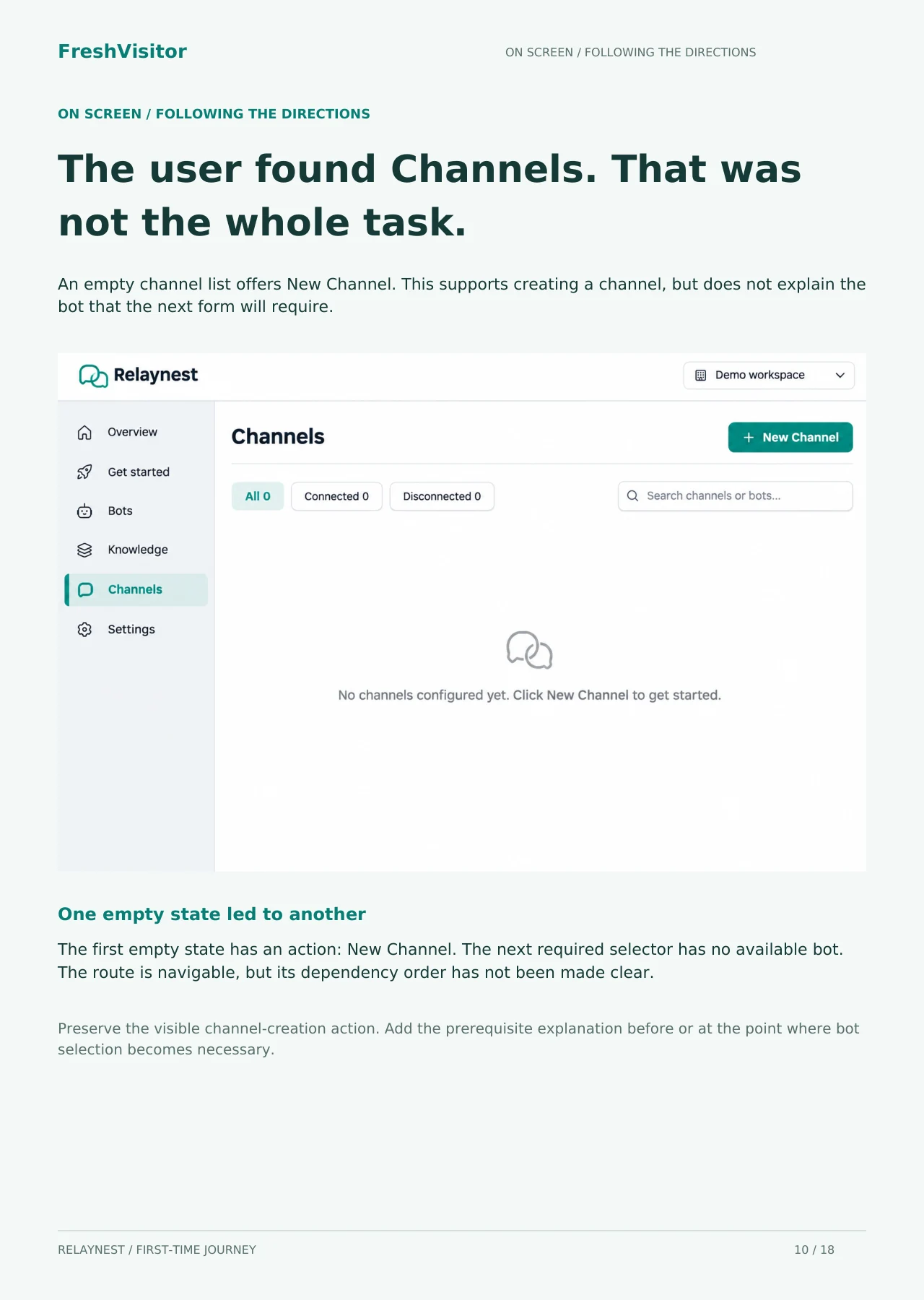
FreshVisitor ON SCREEN / FOLLOWING THE DIRECTIONS RELAYNEST / FIRST-TIME JOURNEY 10 / 18 ON SCREEN / FOLLOWING THE DIRECTIONS The user found Channels. That was not the whole task. An empty channel list offers New Channel. This supports creating a channel, but does not explain the bot that the next form will require. One empty state led to another The first empty state has an action: New Channel. The next required selector has no available bot. The route is navigable, but its dependency order has not been made clear. Preserve the visible channel-creation action. Add the prerequisite explanation before or at the point where bot selection becomes necessary.
Read page 11 text
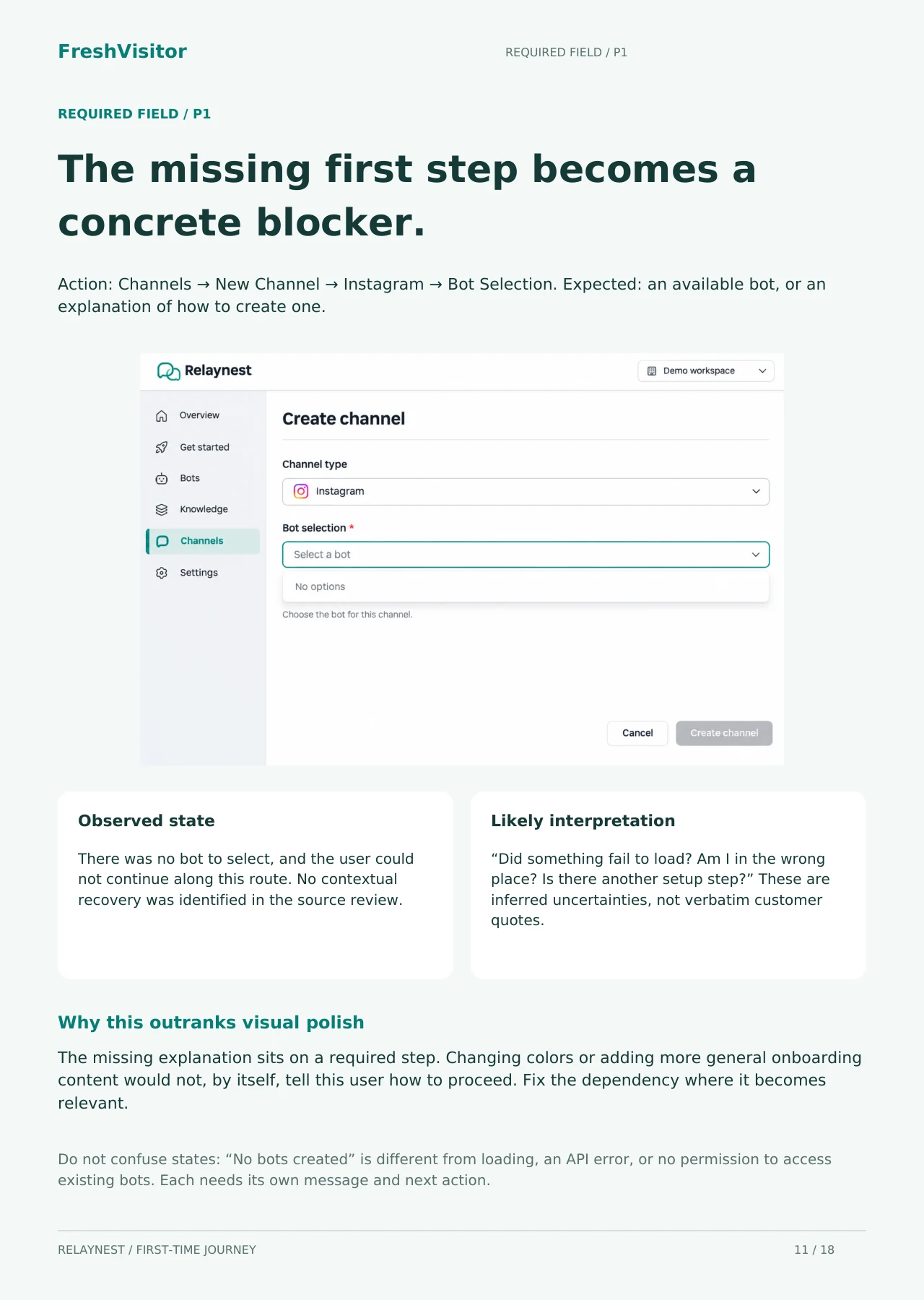
FreshVisitor REQUIRED FIELD / P1 RELAYNEST / FIRST-TIME JOURNEY 11 / 18 REQUIRED FIELD / P1 The missing first step becomes a concrete blocker. Action: Channels → New Channel → Instagram → Bot Selection. Expected: an available bot, or an explanation of how to create one. Observed state There was no bot to select, and the user could not continue along this route. No contextual recovery was identified in the source review. Likely interpretation “Did something fail to load? Am I in the wrong place? Is there another setup step?” These are inferred uncertainties, not verbatim customer quotes. Why this outranks visual polish The missing explanation sits on a required step. Changing colors or adding more general onboarding content would not, by itself, tell this user how to proceed. Fix the dependency where it becomes relevant. Do not confuse states: “No bots created” is different from loading, an API error, or no permission to access existing bots. Each needs its own message and next action.
Read page 12 text
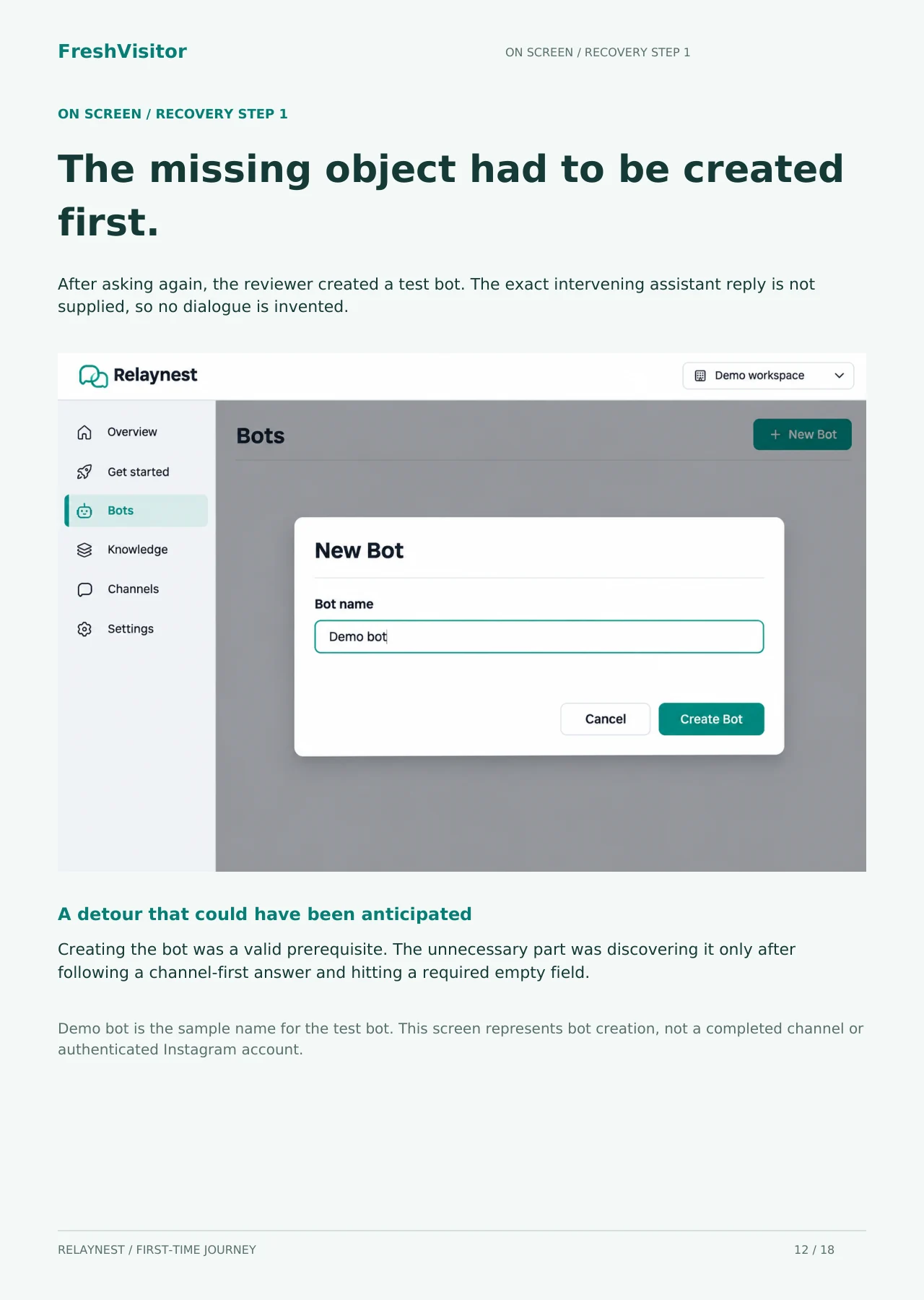
FreshVisitor ON SCREEN / RECOVERY STEP 1 RELAYNEST / FIRST-TIME JOURNEY 12 / 18 ON SCREEN / RECOVERY STEP 1 The missing object had to be created first. After asking again, the reviewer created a test bot. The exact intervening assistant reply is not supplied, so no dialogue is invented. A detour that could have been anticipated Creating the bot was a valid prerequisite. The unnecessary part was discovering it only after following a channel-first answer and hitting a required empty field. Demo bot is the sample name for the test bot. This screen represents bot creation, not a completed channel or authenticated Instagram account.
Read page 13 text
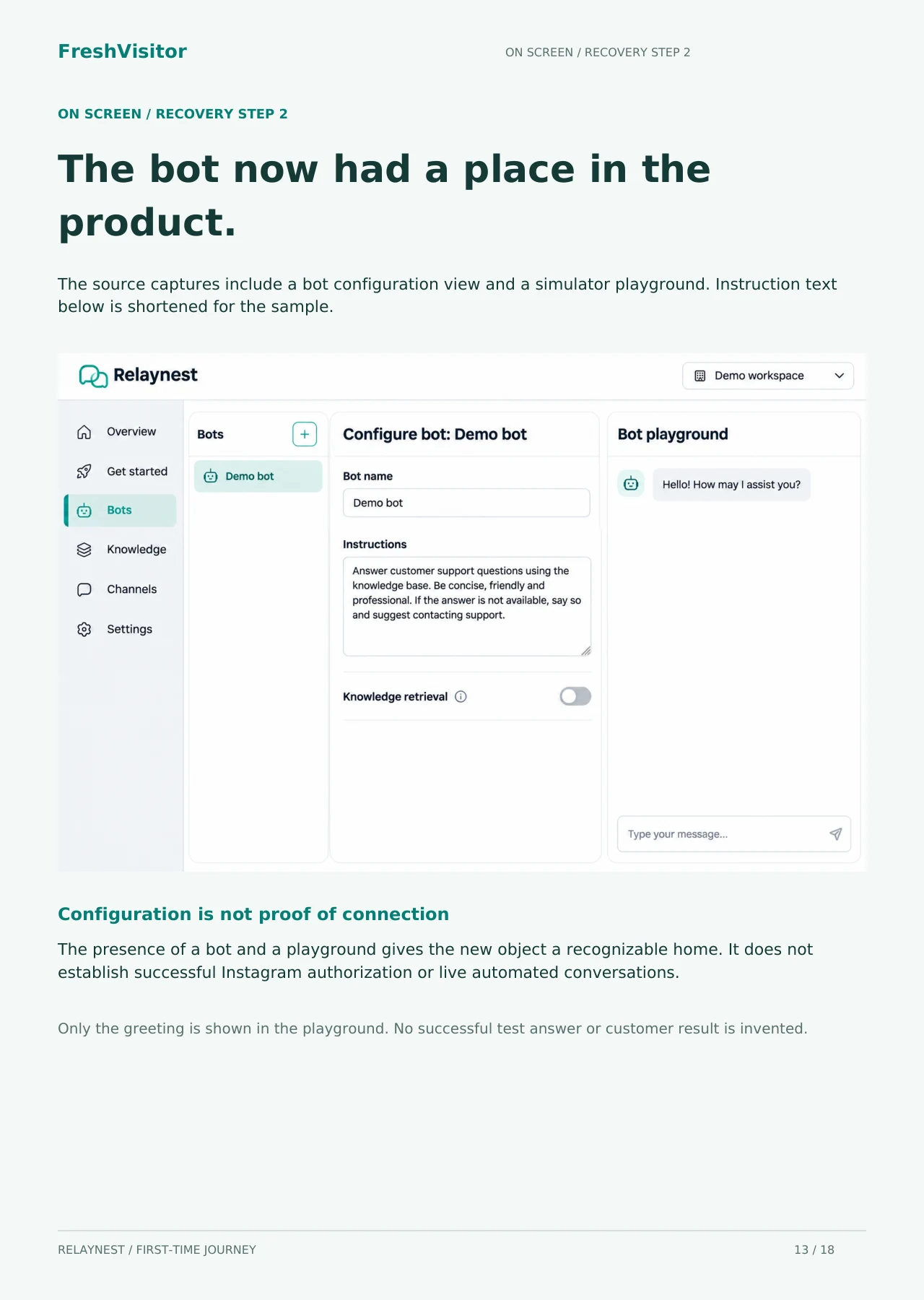
FreshVisitor ON SCREEN / RECOVERY STEP 2 RELAYNEST / FIRST-TIME JOURNEY 13 / 18 ON SCREEN / RECOVERY STEP 2 The bot now had a place in the product. The source captures include a bot configuration view and a simulator playground. Instruction text below is shortened for the sample. Configuration is not proof of connection The presence of a bot and a playground gives the new object a recognizable home. It does not establish successful Instagram authorization or live automated conversations. Only the greeting is shown in the playground. No successful test answer or customer result is invented.
Read page 14 text
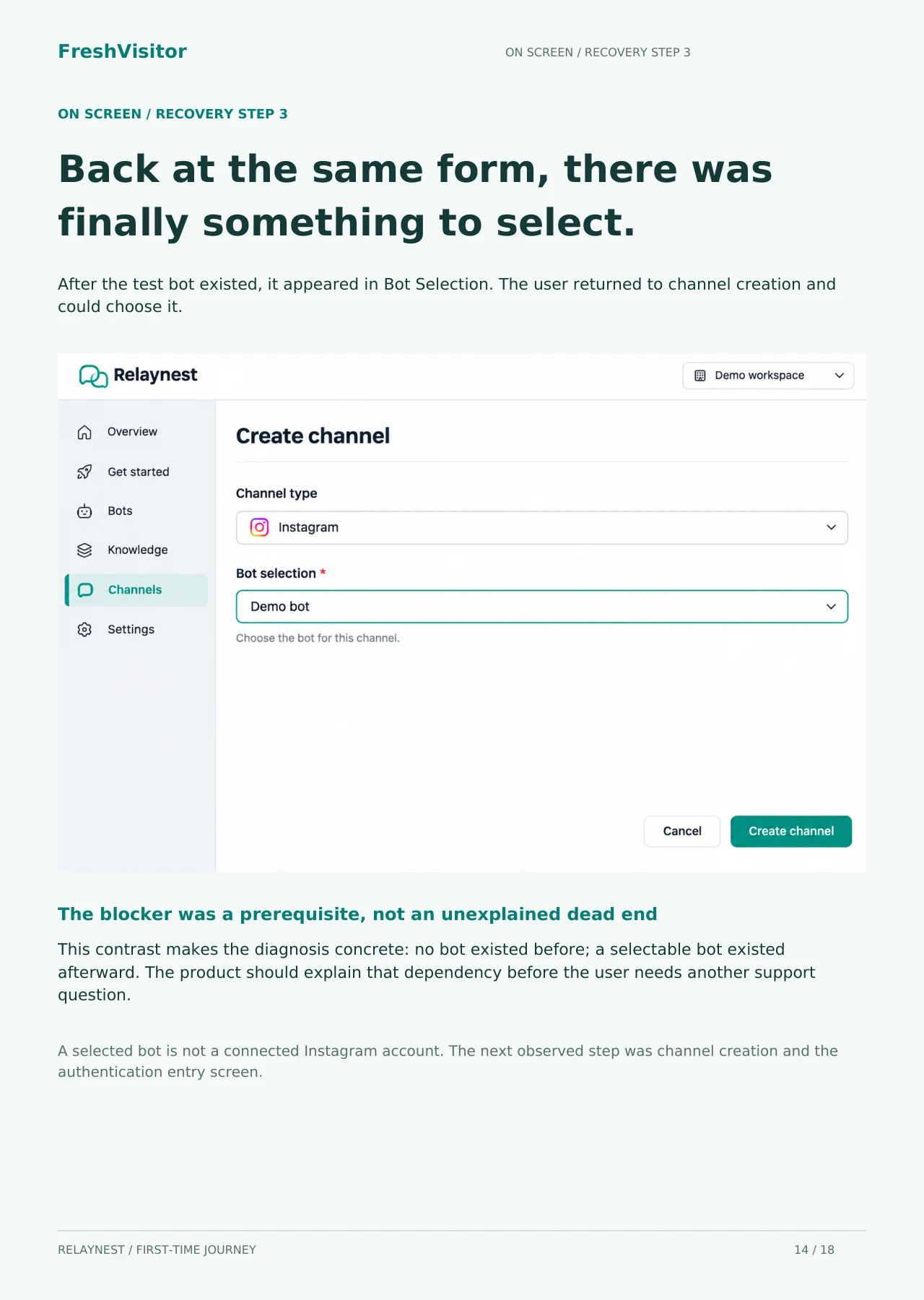
FreshVisitor ON SCREEN / RECOVERY STEP 3 RELAYNEST / FIRST-TIME JOURNEY 14 / 18 ON SCREEN / RECOVERY STEP 3 Back at the same form, there was finally something to select. After the test bot existed, it appeared in Bot Selection. The user returned to channel creation and could choose it. The blocker was a prerequisite, not an unexplained dead end This contrast makes the diagnosis concrete: no bot existed before; a selectable bot existed afterward. The product should explain that dependency before the user needs another support question. A selected bot is not a connected Instagram account. The next observed step was channel creation and the authentication entry screen.
Read page 15 text
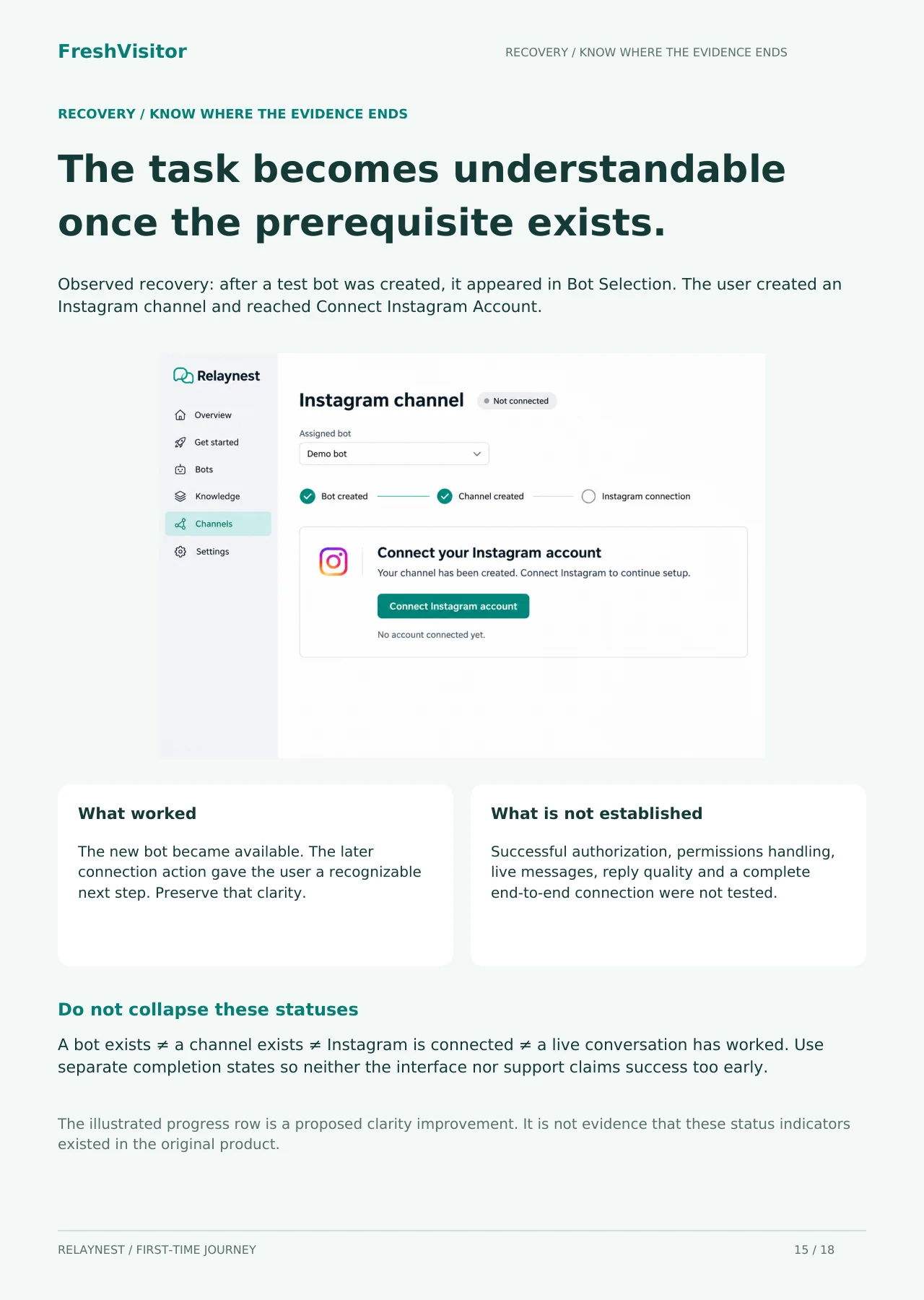
FreshVisitor RECOVERY / KNOW WHERE THE EVIDENCE ENDS RELAYNEST / FIRST-TIME JOURNEY 15 / 18 RECOVERY / KNOW WHERE THE EVIDENCE ENDS The task becomes understandable once the prerequisite exists. Observed recovery: after a test bot was created, it appeared in Bot Selection. The user created an Instagram channel and reached Connect Instagram Account. What worked The new bot became available. The later connection action gave the user a recognizable next step. Preserve that clarity. What is not established Successful authorization, permissions handling, live messages, reply quality and a complete end-to-end connection were not tested. Do not collapse these statuses A bot exists ≠ a channel exists ≠ Instagram is connected ≠ a live conversation has worked. Use separate completion states so neither the interface nor support claims success too early. The illustrated progress row is a proposed clarity improvement. It is not evidence that these status indicators existed in the original product.
Read page 16 text
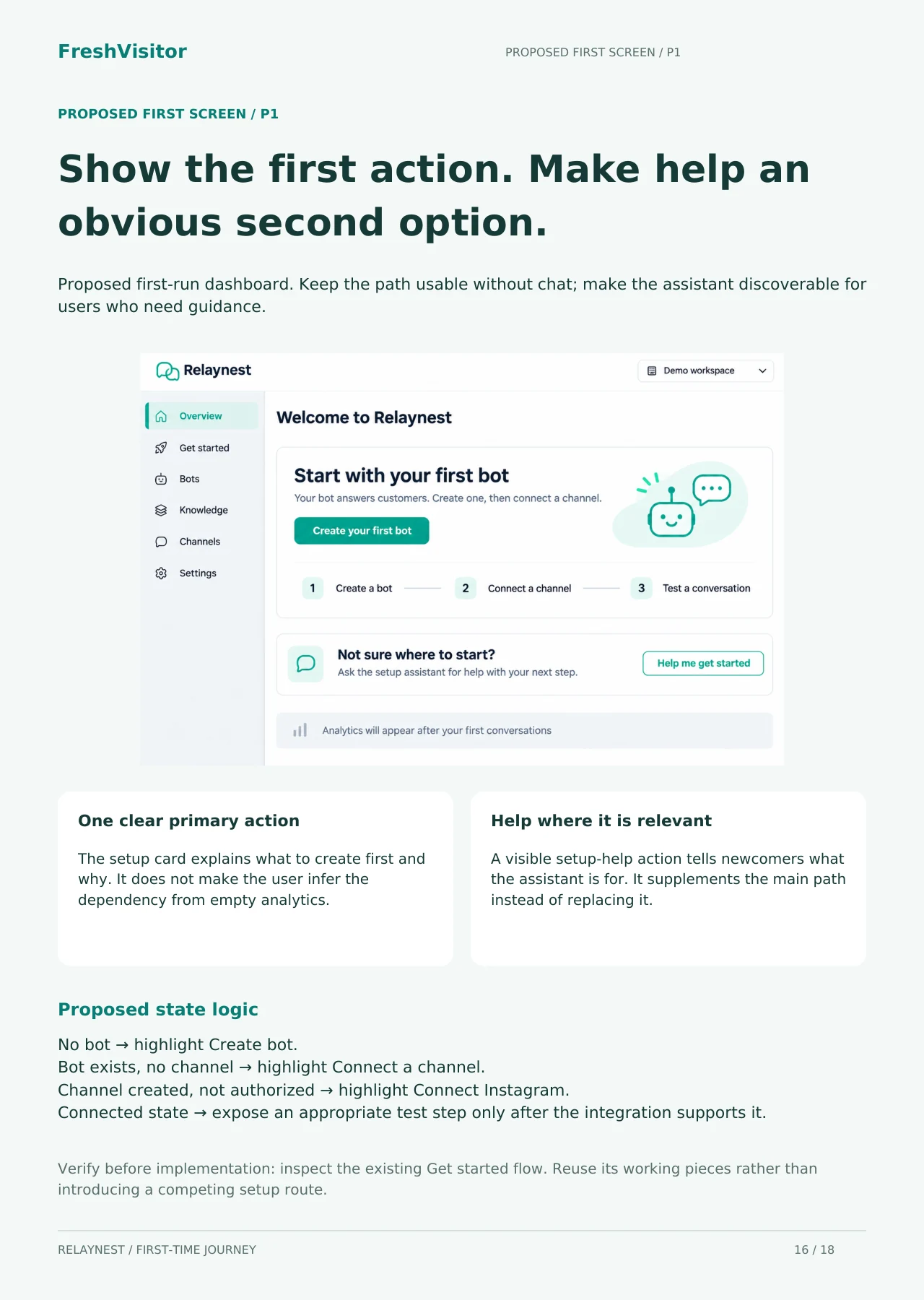
FreshVisitor PROPOSED FIRST SCREEN / P1 RELAYNEST / FIRST-TIME JOURNEY 16 / 18 PROPOSED FIRST SCREEN / P1 Show the first action. Make help an obvious second option. Proposed first-run dashboard. Keep the path usable without chat; make the assistant discoverable for users who need guidance. One clear primary action The setup card explains what to create first and why. It does not make the user infer the dependency from empty analytics. Help where it is relevant A visible setup-help action tells newcomers what the assistant is for. It supplements the main path instead of replacing it. Proposed state logic No bot → highlight Create bot. Bot exists, no channel → highlight Connect a channel. Channel created, not authorized → highlight Connect Instagram. Connected state → expose an appropriate test step only after the integration supports it. Verify before implementation: inspect the existing Get started flow. Reuse its working pieces rather than introducing a competing setup route.
Read page 17 text
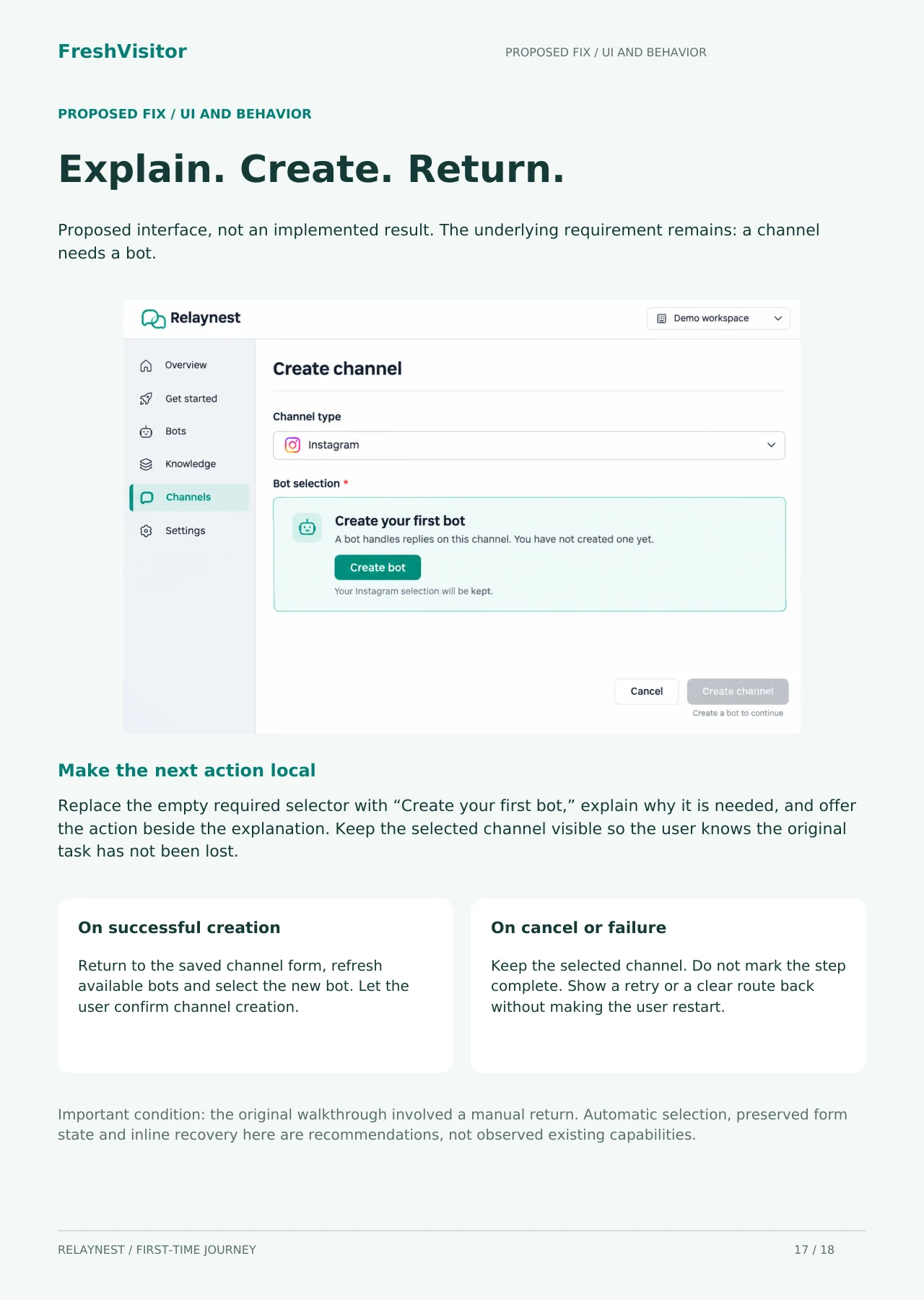
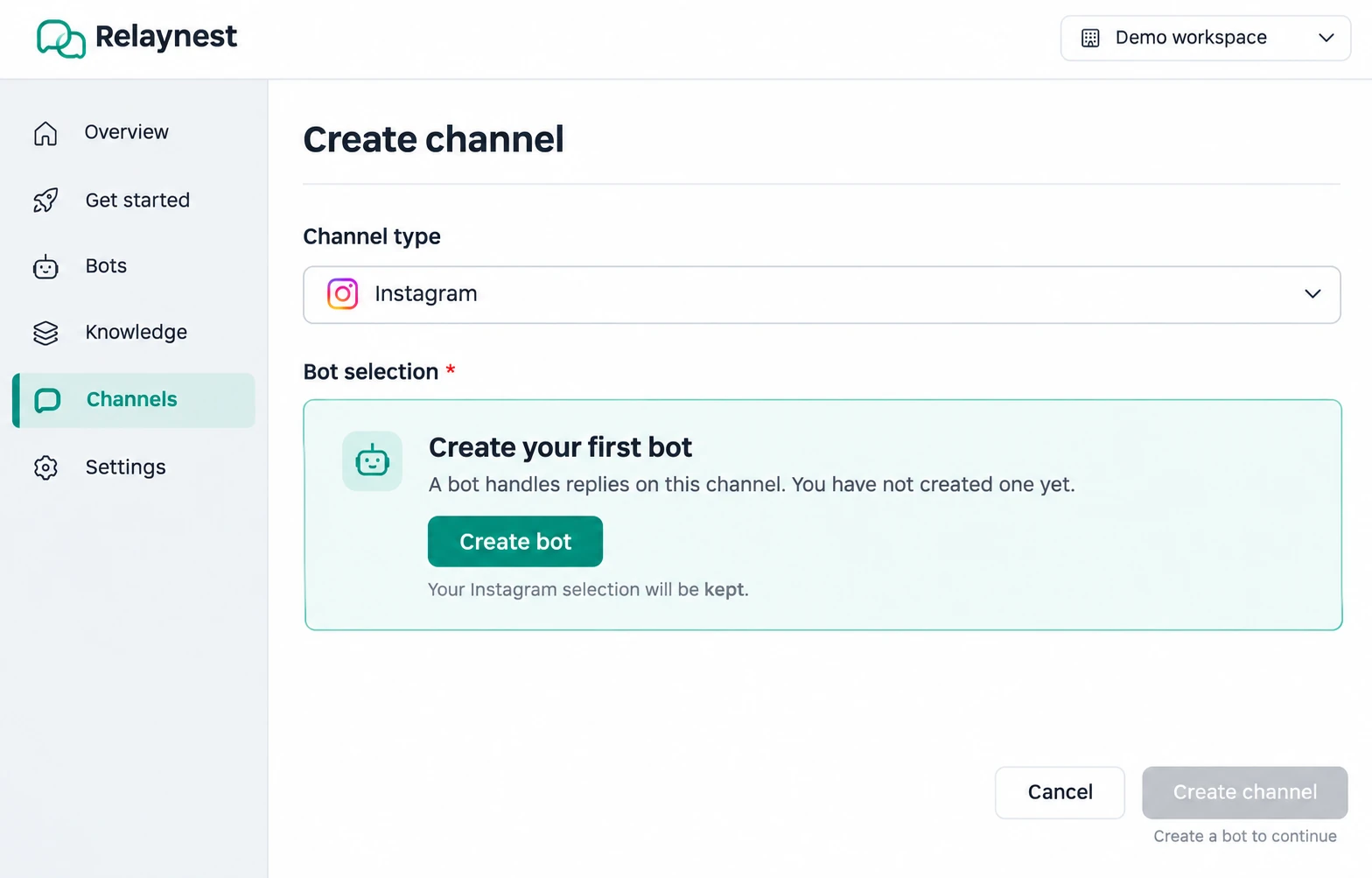
FreshVisitor PROPOSED FIX / UI AND BEHAVIOR RELAYNEST / FIRST-TIME JOURNEY 17 / 18 PROPOSED FIX / UI AND BEHAVIOR Explain. Create. Return. Proposed interface, not an implemented result. The underlying requirement remains: a channel needs a bot. Make the next action local Replace the empty required selector with “Create your first bot,” explain why it is needed, and offer the action beside the explanation. Keep the selected channel visible so the user knows the original task has not been lost. On successful creation Return to the saved channel form, refresh available bots and select the new bot. Let the user confirm channel creation. On cancel or failure Keep the selected channel. Do not mark the step complete. Show a retry or a clear route back without making the user restart. Important condition: the original walkthrough involved a manual return. Automatic selection, preserved form state and inline recovery here are recommendations, not observed existing capabilities.
Read page 18 text
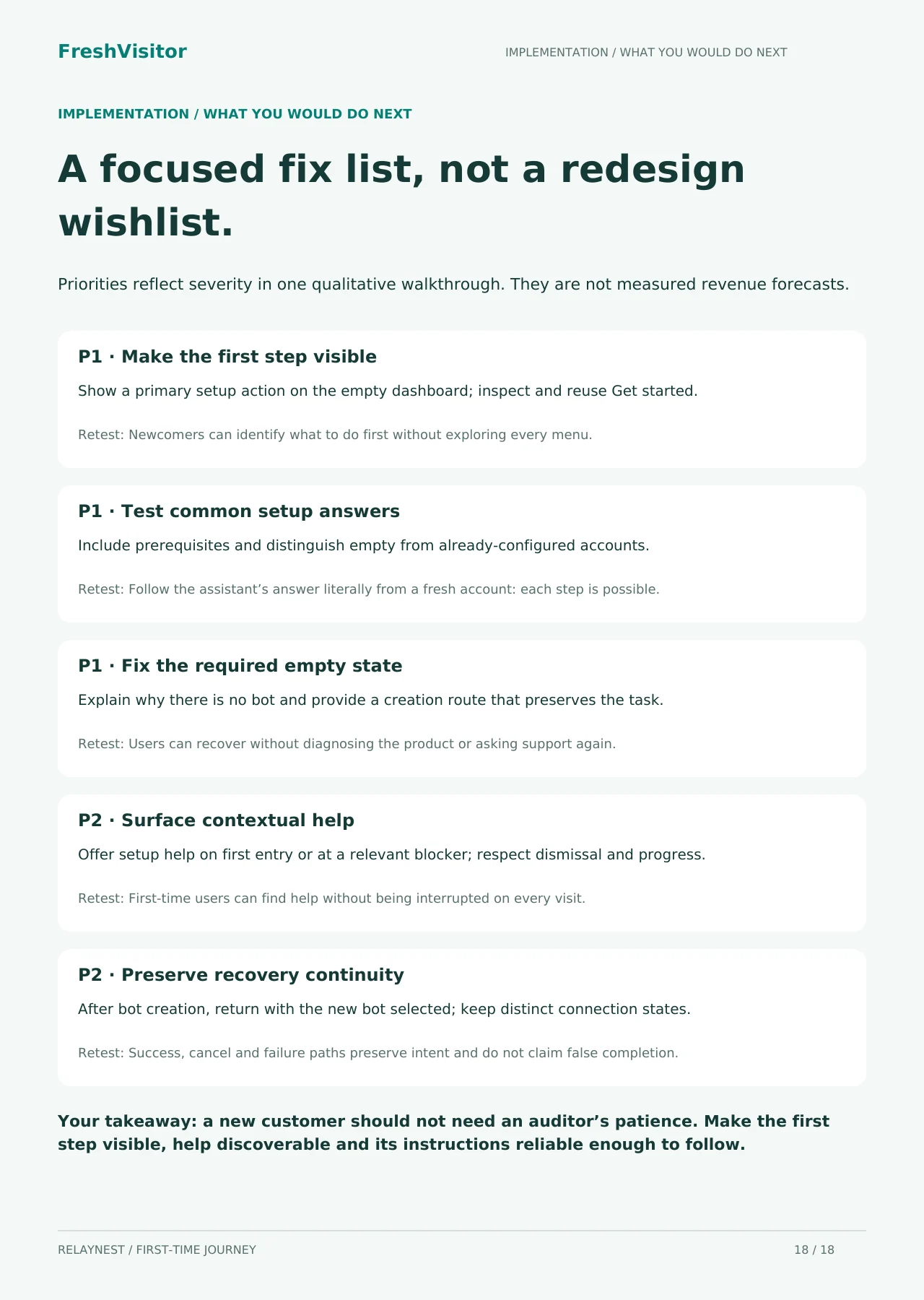
FreshVisitor IMPLEMENTATION / WHAT YOU WOULD DO NEXT RELAYNEST / FIRST-TIME JOURNEY 18 / 18 IMPLEMENTATION / WHAT YOU WOULD DO NEXT A focused fix list, not a redesign wishlist. Priorities reflect severity in one qualitative walkthrough. They are not measured revenue forecasts. P1 · Make the first step visible Show a primary setup action on the empty dashboard; inspect and reuse Get started. Retest: Newcomers can identify what to do first without exploring every menu. P1 · Test common setup answers Include prerequisites and distinguish empty from already-configured accounts. Retest: Follow the assistant’s answer literally from a fresh account: each step is possible. P1 · Fix the required empty state Explain why there is no bot and provide a creation route that preserves the task. Retest: Users can recover without diagnosing the product or asking support again. P2 · Surface contextual help Offer setup help on first entry or at a relevant blocker; respect dismissal and progress. Retest: First-time users can find help without being interrupted on every visit. P2 · Preserve recovery continuity After bot creation, return with the new bot selected; keep distinct connection states. Retest: Success, cancel and failure paths preserve intent and do not claim false completion. Your takeaway: a new customer should not need an auditor’s patience. Make the first step visible, help discoverable and its instructions reliable enough to follow.
01 / Starting point
Easy to enter.
Harder to begin.
Goal: learn how to start using a new account. Instagram setup became the concrete task used to follow the first-run guidance.
Observed: email-code signup was straightforward. The dashboard opened on zero counts, resource limits and empty analytics.
“Get started” was visible in the sidebar, and a small chat launcher was present. Their presence did not make the main screen’s first action clear in this walkthrough.
The reviewer kept exploring because they were auditing the product and found the assistant. We haven’t established that ordinary new users would do the same. The full Get started flow was not evaluated.
 Enlarge screen ↗
02 / Asking the product for help
The advice looked complete.
Exact question in the sample“I’m a new user, and I want to connect my Instagram account. What do I need to do?”
Visible answer, summarized:
- Open Channels.
- Create a new channel.
- Choose Instagram.
- Assign a bot.
- Authenticate Instagram.
The missing prerequisite: this new account had no bot. Nothing in the preceding steps created one.
The screenshot uses the original question and a condensed visible answer. The full bottom of the original reply is not visible; no continuation is invented.
 Enlarge screen ↗
03 / Following the directions
Navigation help didn’t resolve
the dependency.
The next question was “Can you take me to that page?” The visible assistant reply said it could guide the user there, then described finding Channels in the navigation.
Behind the chat, the Create Channel form was already open with Instagram selected. Bot Selection still showed its placeholder.
Read the problem drafted in the composer
“I’m trying to connect my Instagram account, but when I click the dropdown to assign a bot, no available bots show up, so I can’t move on to the next step.”
This is text in the composer, not a confirmed sent bubble. The navigation answer above it is not a reply to this draft.
The narrative separately records asking again and creating a bot. The exact intervening assistant reply is not supplied.
 Enlarge screen ↗
04 / Required field
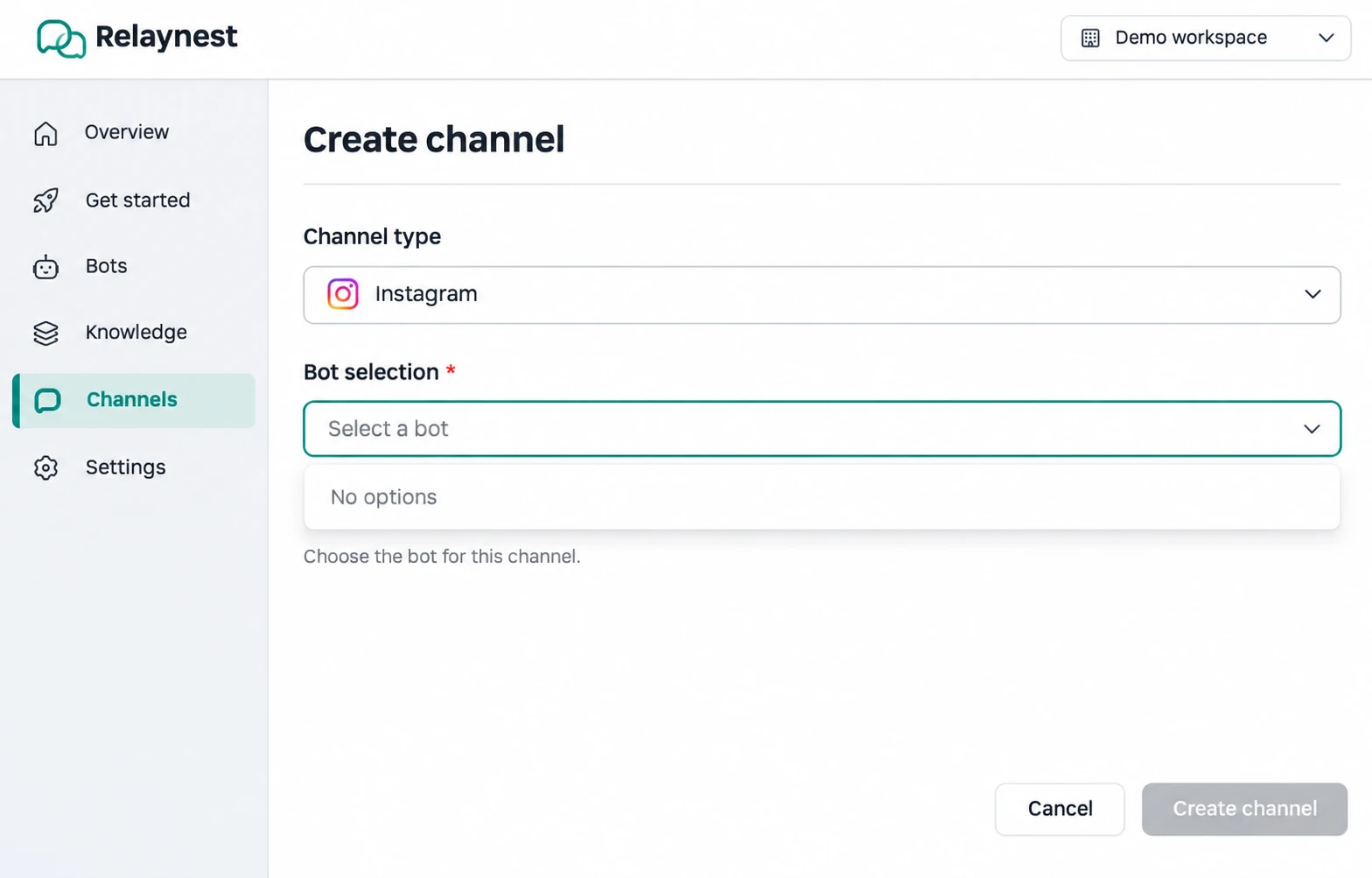
“Select a bot.”
No options to select.
Action: Channels → New Channel → Instagram → Bot Selection.
Expectation: an available bot, or an explanation of how to create one.
Observed: no bot was available and the reviewer could not proceed along this route. No contextual recovery was identified in the source review.
Interpretation: a newcomer has to diagnose whether something failed to load, they are in the wrong place, or they missed setup. These are inferred uncertainties, not verbatim customer quotes.
This takes priority over visual polish because it blocks a required step.
 Enlarge screen ↗
05 / Leaving the task and returning
Create first.
Then come back.
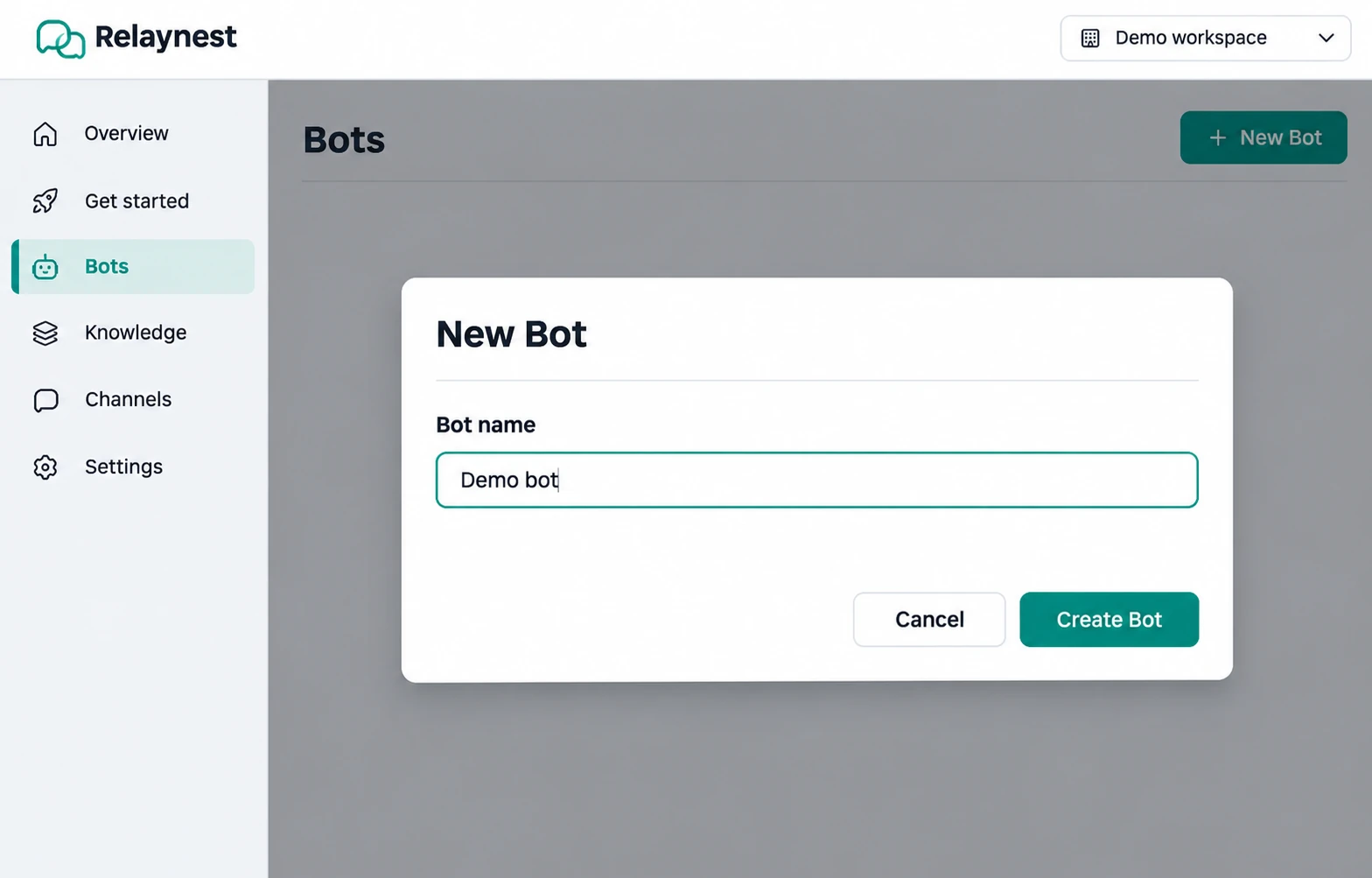
After asking again, the reviewer created a test bot. Demo bot is its sample name.
Bot creation was a valid prerequisite. Discovering it only after a channel-first answer and an empty required field was the avoidable detour.
This screen represents bot creation, not an authenticated channel or successful conversation.
 Enlarge screen ↗
06 / Recovery observed
The same form.
Now a selectable bot.
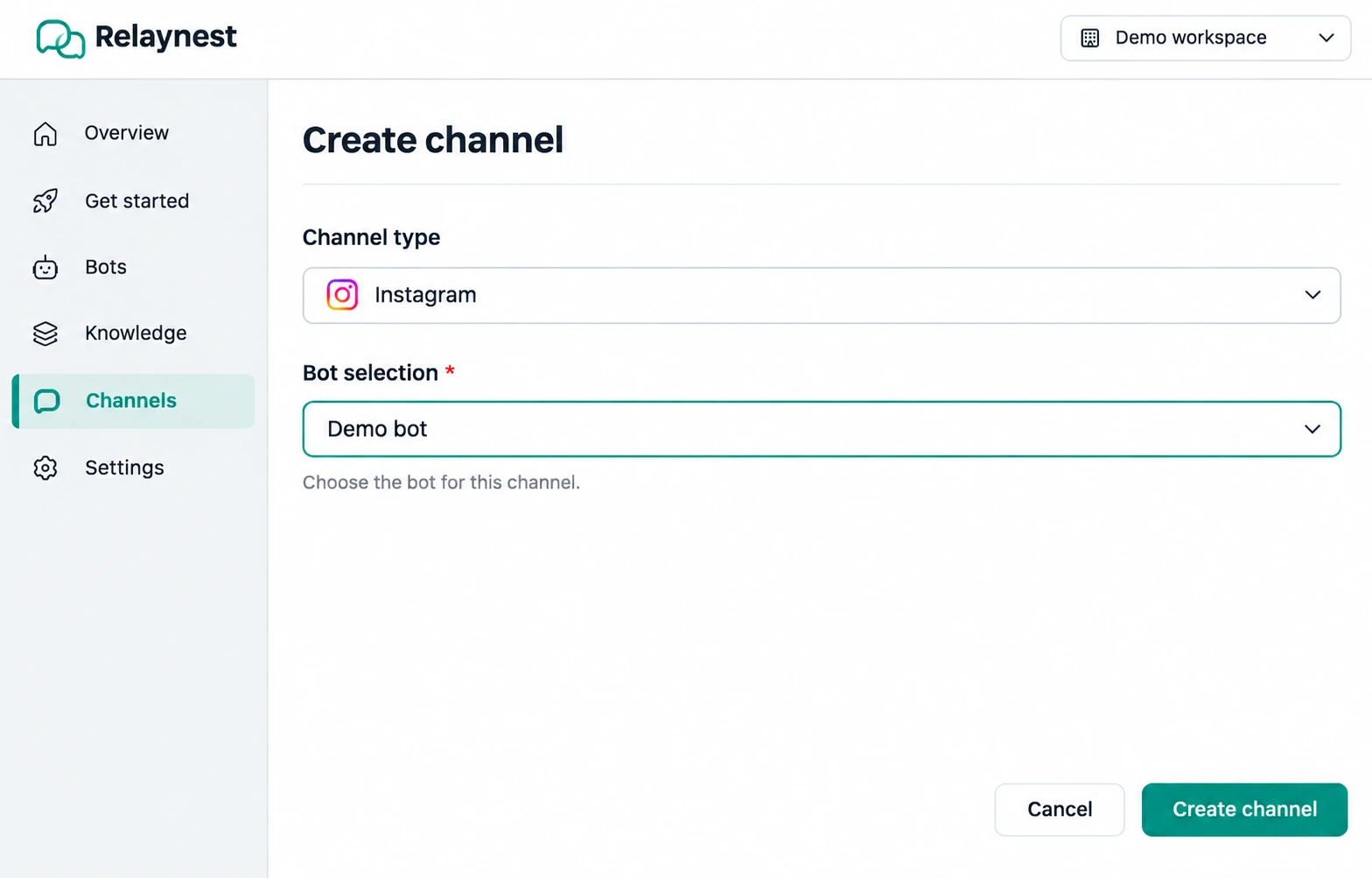
After the bot existed, the reviewer manually returned to channel creation and could select it. The channel was created and the walkthrough reached Connect Instagram Account.
Keep: the later connection action provides a recognizable next step.
Evidence ends here. Instagram authorization, permission handling, live messages and reply quality were not tested. A bot exists ≠ a channel exists ≠ the account is connected ≠ a live conversation worked.
 Enlarge screen ↗
07 / Proposed change
Explain. Create. Return.
Proposal, not an implemented result
At the empty field, explain that a channel needs a bot and offer Create your first bot. Keep the selected channel visible so the original task stays clear.
- On success
- Return to the saved form, refresh the available bots and select the new one. Let the user confirm channel creation.
- On cancel or failure
- Preserve the selected channel, show a retry or a route back, and don’t mark setup complete.
Also make the first setup action explicit on the dashboard. Inspect and reuse working parts of Get started before adding a competing path.
 Enlarge screen ↗
08 / What to fix first
A focused change list.
- Make the first action visible. Check that newcomers can identify how to begin without exploring every menu.
- Test setup answers from zero. Ask the same question with no bots and with an existing bot. Follow each answer literally.
- Make the empty required field recoverable. Check that people can continue without diagnosing the product or asking support again.
- Offer help where it is needed. Respect dismissal and progress; avoid repeating prompts on every visit.
- Preserve the task through recovery. Test success, cancel and failure without losing the selected channel or claiming false completion.
Priorities from one qualitative walkthrough, not conversion measurements, revenue forecasts or a representative user study.